Settling of marine snow
Marine aggregates are compositions of (in)organic matter that transfer Carbon Dioxide (CO2 ) from the upper layer to the deep ocean to regulate atmospheric CO2 levels. Their settling motion looks like snow in the ocean.
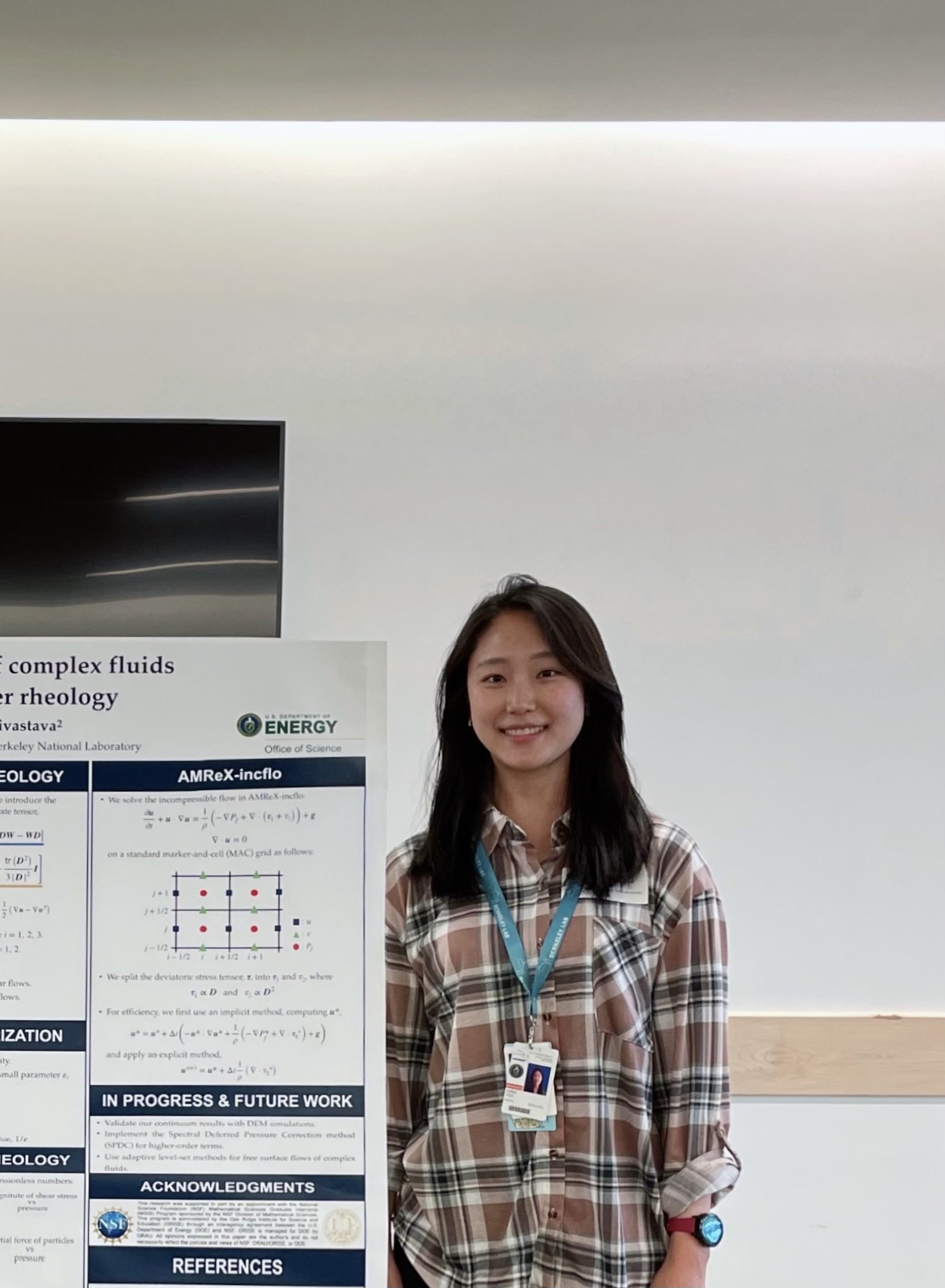
I am a postdoctoral researcher at the National Renewable Energy Laboratory (NREL). My role includes implementing an improved AMReX library code for complex geometry by reading an STL file within the embedded boundary. Having a triangulated surface in an STL format, this project aims to allow AMReX users to have broad options of solid objects for their research in CFD (Computational Fluid Dynamics). As I value my time with co-workers/teammates, I seek a workplace that can expand my knowledge in Applied Mathematics, help me grow professionally, and allow me to maintain a healthy work-life balance as a female researcher.
My primary research interests are modeling and developing stable, accurate, and efficient computational algorithms for multi-physics problems. I obtained my Ph.D. in Applied Mathematics at University of California, Merced, in Summer 2023, under the co-supervision of Dr. Francois Blanchette and Dr. Shilpa Khatri. For my Ph.D. dissertation, I worked on modeling settling marine aggregates in a low Reynolds number regime. We use a boundary integral formulation evaluated with the Fast Multipole Method, a least-square approximation, and finite difference schemes to obtain precise and efficient three-dimensional computation.
In addition to my Ph.D. program, I participated twice in the NSF-MSGI (National Science Foundation Mathematical Sciences Graduate Internship) program. In the summer of 2021, under the mentorship of Dr. Michael Martin at NREL (National Renewable Energy Laboratory), we implemented a Python solver package to solve for properties of helium using its equation of state. I also spent the summer of 2022 at the Center for Computational Sciences and Engineering (CCSE) in LBNL under Dr. Ishan Srivastava’s guidance. We implemented a pressure-dependent viscosity and a nonlinear stress tensor to model complex fluids in the AMReX-incflo.
Marine aggregates are compositions of (in)organic matter that transfer Carbon Dioxide (CO2 ) from the upper layer to the deep ocean to regulate atmospheric CO2 levels. Their settling motion looks like snow in the ocean.
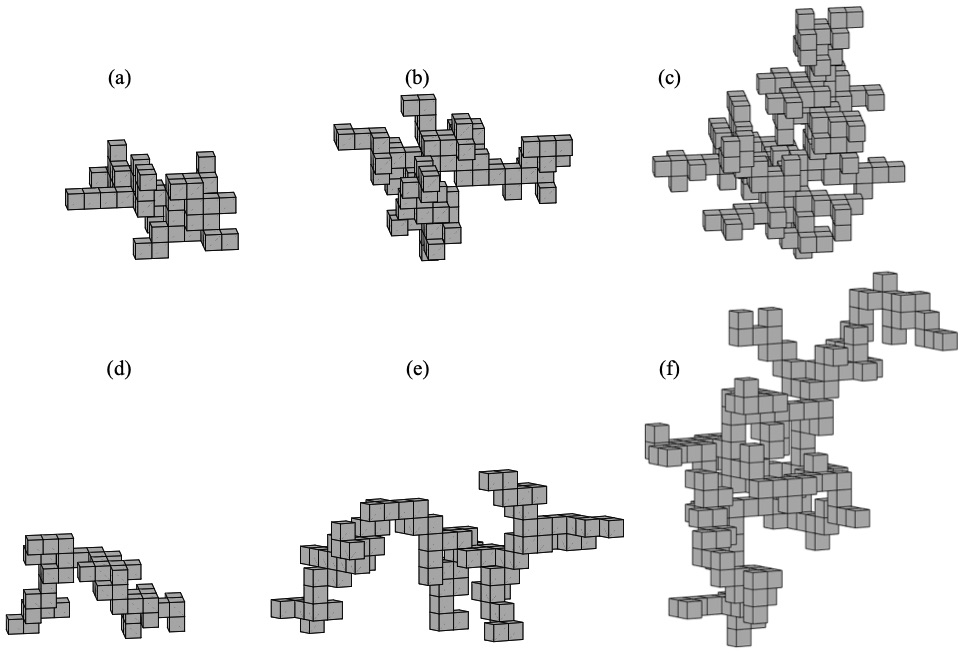
We generate marine aggregates with cubes! This allows us to capture more realistic shapes of aggregates.
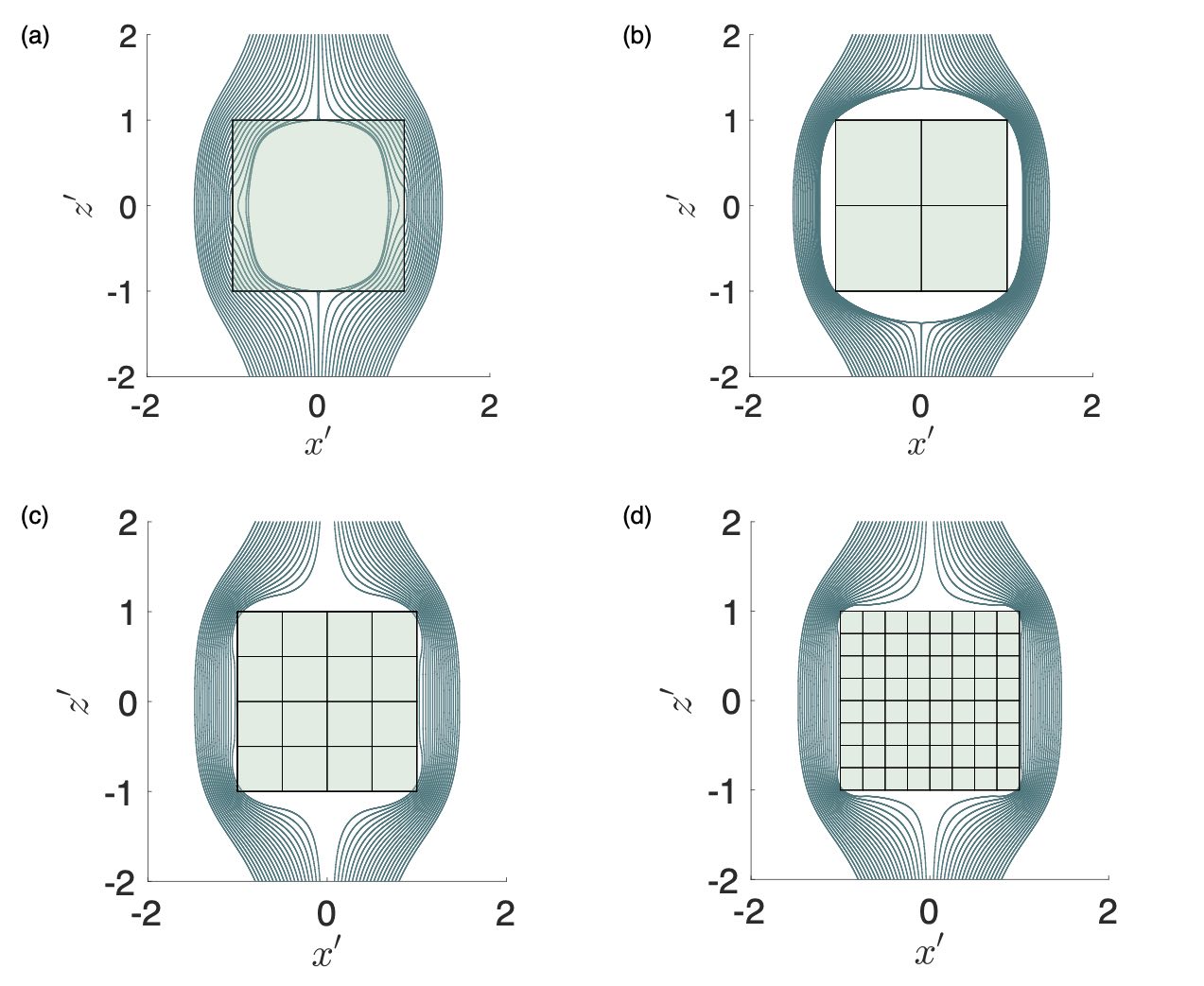
This is a sample of streamlines around aggregates. We can get more accurate lines with higher resolution.
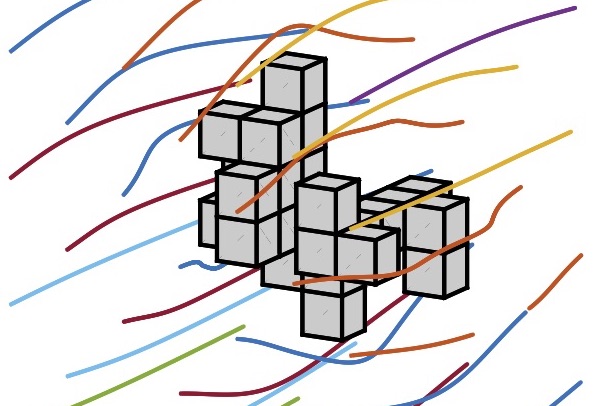
Check out our recent work below!
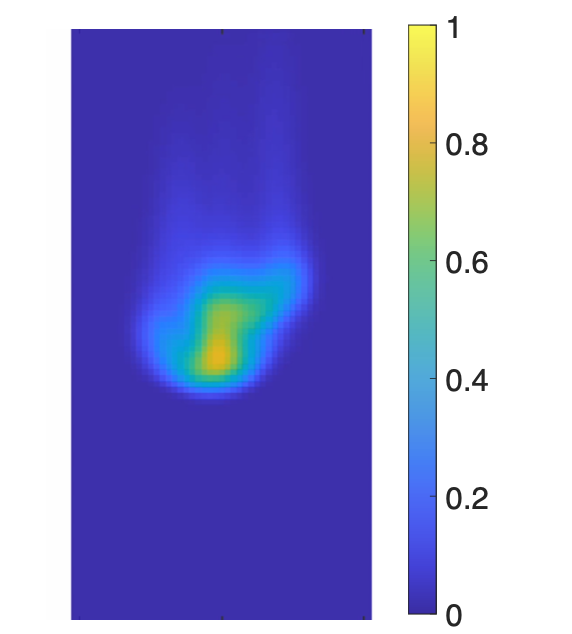
We currently work on settling simulation with advection-diffusion equation in Stokes regime.